
Your child was born curious. Let's keep it that way.
The World National Day Packs give you simple play-based ideas to turn everyday moments into real learning. No worksheets, no battles and no teaching degree required.
Buy NowThe system didn't steal your patience. It stole your child's curiosity.
Most parents think the problem is homework. Or the morning rush. Or the fact that their child just will not sit still and focus. So they try harder. They push more. They nag. And then they feel terrible about it.
But here is what nobody tells you: the real damage is happening quietly in the background. Every worksheet your child fills in, every answer they are told to memorise and every time they are rewarded for getting it "right" instead of asking "why" - their natural curiosity gets a little weaker.
Not because they are lazy. Not because you are doing it wrong. But because a system built for compliance was never designed to protect wonder.
By the time most parents notice something is off, their child has already learned one deeply unhelpful lesson: that learning means waiting to be told the answer. That is not a phase. That is a pattern. And it does not fix itself.
What if learning felt like play - because it actually was?
There is a different way to do this. Not school at home. Not a rigid timetable with subjects and tests. Something far simpler and far more powerful. It starts with a question, leads into play and ends with your child asking you something you never expected.
Start with a question
Each pack begins with a spark: a real world question that draws your child in. No instructions to memorise. Just genuine wonder.
Explore through play
Hands on activities, simple experiments and creative prompts guide discovery. You follow along - no prep, no teaching expertise needed.
Watch the spark catch
Your child stops waiting for answers and starts guessing, testing and asking questions you can't answer off the top of your head.

The Guided Discovery Loop
That is the method at the heart of the World National Day Packs. Each monthly pack is built around a theme your child can explore with their hands, their imagination and their natural sense of wonder. Bees. Trains. Parrots. Real topics that connect to the real world.
You do not need to be a teacher. You just need to follow the prompts, ask the questions and let your child lead. The pack does the rest.
Who this is for
Mothers new to home education
You have just stepped away from the school system or you are seriously thinking about it and you want a simple, clear starting point that does not feel like recreating a classroom.
Parents frustrated with worksheets
Your child switches off the moment a workbook comes out. You know there has to be a better way to learn, but you are not sure where to start or what actually works.
Families who want more connection
You are less worried about test scores and more focused on raising a curious, confident child and you want learning to bring you closer together, not pull you apart.
The Home Education Reality Calculator
Could you afford to home educate? Most families are surprised to find the gap between two incomes and one is much smaller than they think - once you remove the hidden costs of school and work.
Enter your current take-home pay for both earners
The parent who would stop or reduce work
What the home-educating parent could still earn (e.g. evenings, freelance, part-time)
Fixed costs that stay the same either way
Savings, loan repayments, subscriptions, insurance
These costs disappear or shrink when one parent is at home
Monthly train, bus, fuel, parking
Childminder, breakfast club, after-school club, holiday clubs
Grabbing lunch, coffees, convenience meals because no time to cook
Monthly average for professional clothing, dry cleaning
These go away completely when you home educate
If you drive. Leave 0 if using bus/train
If not driving, enter public transport cost
Typically 300/yr for uniform, PE kit, school shoes
Birthday presents, PTA fundraisers, non-uniform days
Home ed families travel off-peak and avoid fines
Your Results
Start by entering your household income to see how the numbers compare.
Future-Ready Learning Checklist
A simple, printable guide to track your child's growth across 8 key areas of development - from thinking and reasoning to creativity and digital awareness.
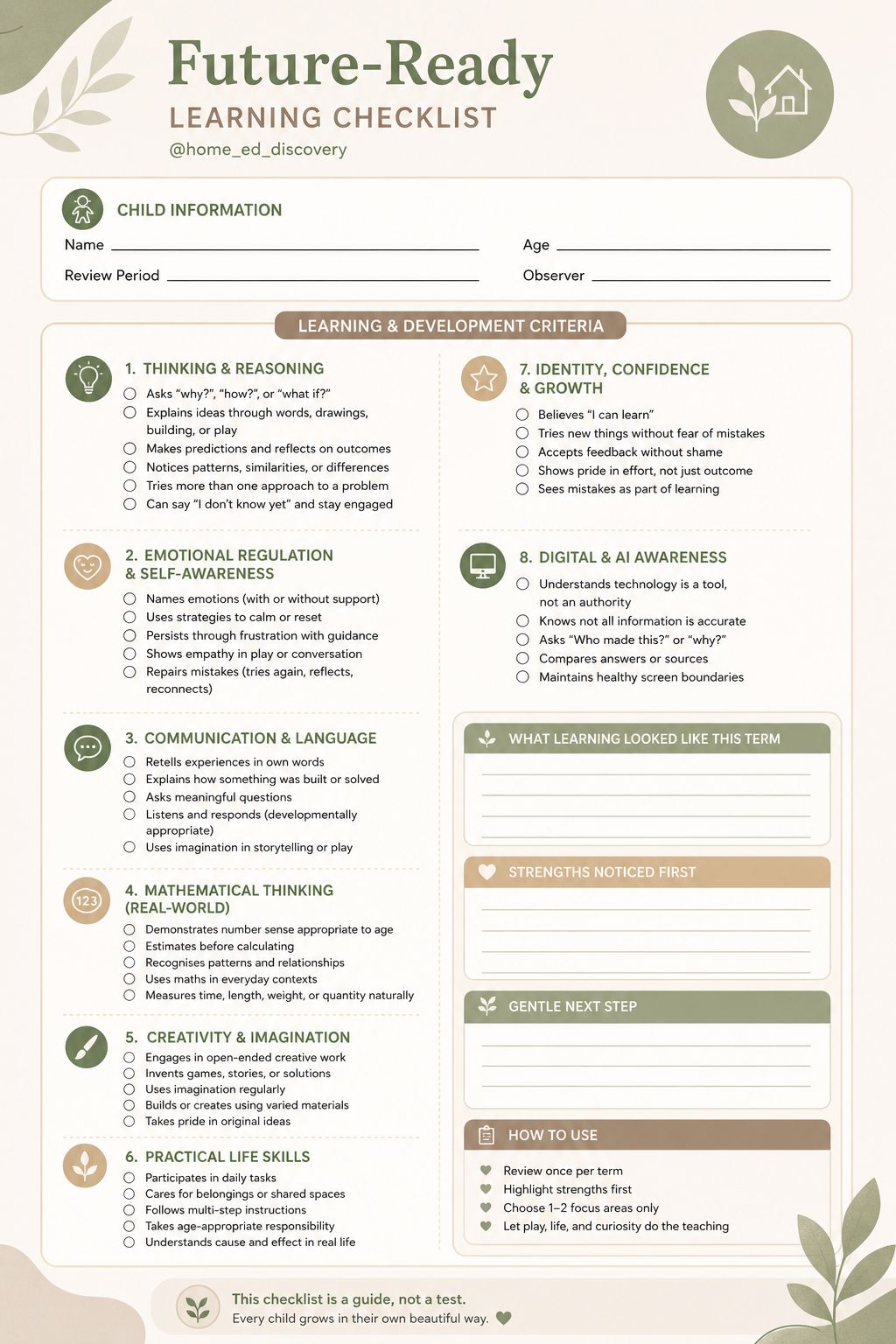
Not a test. A guide.
Every child grows in their own beautiful way. This checklist helps you notice and celebrate that growth across 8 areas that actually matter - thinking, creativity, emotional awareness, communication and more.
- Review once per term to track progress
- Highlight strengths first
- Choose 1-2 focus areas only
- Let play, life and curiosity do the teaching